
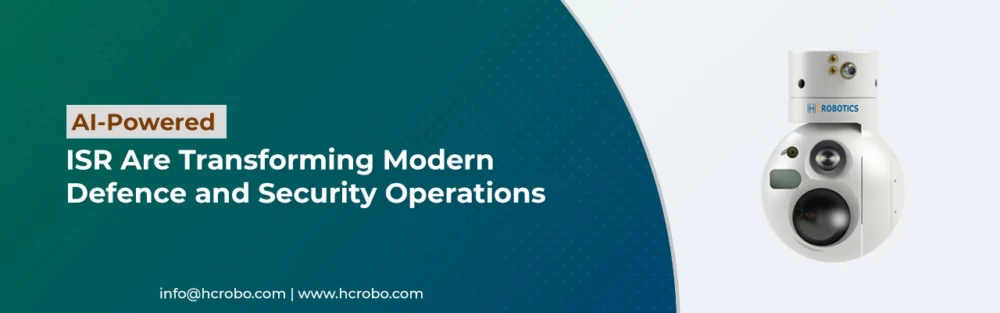
Beyond Surveillance: How EO/IR Cameras, UAVs and AI-Powered ISR Are Transforming Modern Defence and Security Operations
Table of Contents
▾
- Introduction
- The Evolution of Modern Surveillance and ISR
- Understanding EO/IR Cameras
- Why EO/IR Cameras and UAVs Are a Powerful Combination
- The Importance of Stabilized EO/IR Gimbals
- Key Features of an Effective EO/IR Payload
- AI-Powered ISR: Transforming Surveillance into Intelligence
- Edge AI: Intelligence at the Sensor
- Applications Across Defence, Security and Industry
- Global Trends Driving ISR Modernization
- HC Robotics: Advancing Indigenous EO/IR and ISR Capability
- Frequently Asked Questions
- Conclusion
- Related Blogs
Introduction
In today’s operational environment, information superiority has become as critical as firepower. Defence forces, homeland security agencies, critical infrastructure operators and emergency response teams increasingly rely on Intelligence, Surveillance and Reconnaissance (ISR) technologies to gain real-time situational awareness and accelerate decision-making.
The convergence of Unmanned Aerial Vehicles (UAVs), Electro-Optical/Infrared (EO/IR) payloads, Artificial Intelligence (AI), and Edge Computing is reshaping how organizations monitor, detect, identify and respond to emerging threats.
For countries like India, where operational environments range from high-altitude Himalayan regions and dense forests to deserts and critical border zones, persistent day-and-night surveillance is no longer optional. It is a mission-critical capability.
At the center of this transformation are modern EO/IR camera systems mounted on UAV platforms, delivering advanced sensing, long-range observation, AI-assisted analytics and real-time intelligence generation.
The Evolution of Modern Surveillance and ISR
Modern security and defence operations face an increasingly complex threat landscape characterized by:
- Hybrid warfare
- Asymmetric threats
- Cross-border infiltration
- Drone-enabled incursions
- Critical infrastructure attacks
- Dispersed hostile elements
- Rapidly changing tactical situations
Unlike traditional battlefield engagements, modern threats often seek concealment through terrain, darkness, weather conditions and civilian clutter.
As a result, the contest between detection and concealment has become a defining feature of modern operations.
Organizations capable of collecting, processing and acting upon information faster gain a significant operational advantage.
Persistent ISR enables operators to:
- Monitor border regions and vulnerable areas
- Detect unusual activity and movement patterns
- Conduct tactical reconnaissance
- Protect strategic assets
- Secure military installations and critical infrastructure
- Support search and rescue operations
- Improve command and control effectiveness
- Enhance force protection and operational planning
In this environment, maintaining continuous observation often means maintaining the initiative.
Understanding EO/IR Cameras
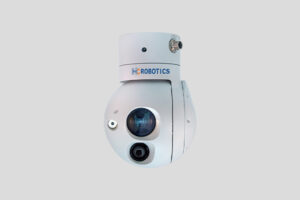
An EO/IR camera combines two complementary imaging technologies into a single surveillance payload.
Electro-Optical (EO) Imaging
EO sensors capture high-definition imagery within the visible spectrum, enabling:
- Daytime surveillance
- Target identification
- Terrain observation
- Infrastructure inspection
- Intelligence gathering
Modern EO systems equipped with high optical zoom provide detailed imagery even at long standoff distances.
Infrared (IR) Thermal Imaging
Unlike visible-light cameras, thermal sensors detect heat signatures.
This capability enables surveillance during:
- Night operations
- Low-light conditions
- Fog and haze
- Camouflaged environments
- Search-and-rescue missions
- Remote observation scenarios
Thermal imaging can reveal personnel, vehicles, equipment and heat-generating objects that might remain hidden to conventional cameras.
Why EO/IR Cameras and UAVs Are a Powerful Combination
A UAV provides mobility, altitude advantage and operational flexibility.
An EO/IR payload provides advanced sensing.
Together, they form a highly effective aerial surveillance platform capable of monitoring large areas efficiently while minimizing risk to personnel.
EO/IR-equipped UAVs support:
- Tactical reconnaissance
- Border surveillance
- Counter-infiltration operations
- ISR missions
- Force protection
- Infrastructure monitoring
- Search and rescue
- Convoy security
- Wildlife monitoring
- Industrial inspections
- Disaster response
Platforms such as HC Robotics’ UAV-M694B further enhance operational effectiveness through:
- HD and 4K video transmission
- EO/IR payload integration
- Real-time situational awareness
- BVLOS-ready architecture
- Modular payload support
The Importance of Stabilized EO/IR Gimbals
Aerial platforms constantly experience movement caused by:
- Wind
- Vibration
- Acceleration
- Aircraft manoeuvres
Without stabilization, surveillance footage becomes difficult to interpret.
Modern EO/IR payloads incorporate gyro-stabilized multi-axis gimbals that maintain a steady line of sight regardless of aircraft movement.
Stabilization becomes especially critical when operating at high zoom levels where even small vibrations can significantly affect image quality.
Key Features of an Effective EO/IR Payload
Selecting an EO/IR camera requires evaluating mission requirements rather than focusing exclusively on resolution.
High Optical Zoom
Long-range surveillance operations benefit from powerful optical zoom capabilities that allow operators to identify distant objects while maintaining image clarity.
Thermal Imaging Performance
Higher thermal sensitivity and resolution improve detection capability in challenging operational environments.
Automatic Detection and Tracking
Advanced payloads can automatically:
- Detect targets
- Track moving objects
- Maintain lock-on
- Reduce operator workload
Geo-Referencing
Geo-referenced imagery associates targets with accurate geographic coordinates, improving tactical awareness and response planning.
Laser Range Finder (LRF)
Optional LRF capability allows operators to determine target distance accurately, enhancing surveillance effectiveness and decision support.
Optimized SWaP
Size, Weight and Power (SWaP) optimization is critical for maximizing UAV endurance while maintaining payload performance.
AI-Powered ISR: Transforming Surveillance into Intelligence
The future of surveillance lies not just in capturing information but in understanding it faster.
Modern AI analytics can automatically:
- Detect personnel
- Identify vehicles
- Recognize unusual behavior
- Classify objects
- Track targets
- Recognize activities
- Detect thermal anomalies
- Perform Automatic Number Plate Recognition (ANPR)
Rather than relying entirely on human operators to monitor multiple video feeds simultaneously, AI acts as a force multiplier by highlighting potentially significant events.
This significantly reduces the sensor-to-decision timeline and improves mission effectiveness.
Edge AI: Intelligence at the Sensor
One of the most important developments in modern ISR is Edge AI.
Traditional surveillance systems often transmit large volumes of data to centralized servers for analysis. This can introduce latency and dependence on network availability.
Edge AI moves processing closer to the sensor by performing inference directly on:
- Drones
- Embedded computers
- Edge devices
- Tactical processing units
Benefits include:
- Lower latency
- Faster threat detection
- Reduced bandwidth consumption
- Real-time decision support
- Improved resilience in contested environments
For operations conducted in remote or communication-constrained regions, Edge AI can become a significant operational advantage.
Applications Across Defence, Security and Industry
Defence and Military ISR
EO/IR-equipped UAVs support:
- Border surveillance
- Counter-infiltration missions
- Tactical reconnaissance
- Forward post monitoring
- Force protection
- Battlefield observation
- Strategic asset protection
High-Altitude Operations
In mountain warfare environments such as Ladakh and Siachen, EO/IR-equipped drones can monitor:
- Ridge lines
- Mountain passes
- Valley approaches
- Potential ingress routes
- Remote military positions
Forest Surveillance
Thermal imaging helps detect:
- Concealed personnel
- Vehicle movement
- Hidden activity
- Heat signatures beneath vegetation
Desert Monitoring
Long-range EO/IR systems provide extended observation capability across vast open terrain.
Critical Infrastructure Security
EO/IR drone systems assist in monitoring:
- Military facilities
- Energy infrastructure
- Pipelines
- Communication networks
- Industrial assets
- Transportation corridors
They provide a flexible and cost-effective surveillance layer while reducing personnel exposure.
Industrial Inspection
EO/IR payloads support inspection of:
- Power transmission lines
- Solar farms
- Refineries
- Construction projects
- Remote infrastructure
- Large industrial facilities
Thermal imaging often reveals issues that may not be visible through conventional cameras.
Search and Rescue Operations
Thermal sensors help identify heat signatures across difficult terrain, enabling faster location of missing persons during emergencies.
Wildlife Monitoring
Combining thermal imaging with AI allows efficient monitoring and classification of wildlife activity during night-time operations.
Global Trends Driving ISR Modernization
Worldwide, defence and security organizations are moving toward integrated surveillance ecosystems combining:
- UAV platforms
- EO/IR sensors
- AI analytics
- Radar systems
- Edge computing
- Multi-source intelligence fusion
Key trends include:
Persistent Surveillance
Continuous observation replacing periodic monitoring.
AI-Assisted Intelligence
Automated analytics reducing operator workload.
Edge Processing
Faster intelligence generation closer to the sensor.
Distributed ISR Networks
Connected sensing architectures replacing isolated surveillance platforms.
These developments are rapidly becoming foundational to military effectiveness and modern security operations.
HC Robotics: Advancing Indigenous EO/IR and ISR Capability
As India strengthens its focus on defence self-reliance, indigenous ISR technologies are becoming increasingly important.
HC Robotics develops integrated solutions that combine:
- UAV platforms
- EO/IR camera systems
- AI-enabled image analytics
- Edge computing technologies
- Mission-specific ISR solutions
The company’s EO/IR portfolio includes:
- Chakshu 18
- Chakshu 218Z
- Chakshu 218ZR
- HDL50L
- HDL75
Key capabilities include:
- Full HD EO imaging
- Thermal imaging
- High optical zoom
- Gyro-stabilized gimbals
- Automatic target tracking
- AI-assisted analytics
- Optional laser range finding
These systems support:
- Tactical ISR
- Border surveillance
- Homeland security
- Force protection
- Strategic infrastructure monitoring
- Aerial reconnaissance
- Search and rescue operations
Beyond technology, indigenous development enables rapid customization, local support and faster adaptation to evolving mission requirements.
Frequently Asked Questions
An EO/IR camera combines visible-light (EO) and thermal infrared (IR) imaging, enabling surveillance in both daytime and low-light or night-time conditions.
Why are EO/IR cameras used on drones?
They provide aerial surveillance, reconnaissance, inspection, and monitoring capabilities while covering large areas quickly and safely.
Can EO/IR cameras work at night?
Yes. Thermal sensors detect heat signatures, allowing effective surveillance in darkness and challenging visibility conditions.
What is the difference between EO and thermal imaging?
EO cameras capture visible-light images, while thermal cameras detect heat emitted by objects, making them useful for night operations and target detection.
What is a stabilized EO/IR gimbal?
A stabilized gimbal compensates for drone movement and vibration, ensuring clear and steady imagery during flight.
How does AI improve EO/IR surveillance?
AI can automatically detect people, vehicles, and unusual activities, helping operators identify threats faster and reducing monitoring workload.
What is Edge AI in drone surveillance?
Edge AI processes data directly on the drone or nearby device, enabling faster detection, lower latency, and reduced dependence on communication networks.
What are the main applications of EO/IR-equipped UAVs?
They are widely used for:
- Border surveillance
- Tactical reconnaissance
- Critical infrastructure security
- Industrial inspection
- Wildlife monitoring
What should I consider when choosing an EO/IR payload?
Key factors include optical zoom, thermal performance, stabilization, payload weight, detection range, power consumption, and UAV compatibility.
Does HC Robotics provide EO/IR surveillance solutions?
Yes. HC Robotics develops indigenous UAV, EO/IR payload, AI analytics, and Edge AI solutions for defence, homeland security, infrastructure monitoring, and industrial applications.
Conclusion
The combination of UAVs, EO/IR cameras, Artificial Intelligence and Edge Computing is transforming modern surveillance, reconnaissance and situational awareness.
Whether deployed for defence, homeland security, infrastructure protection, industrial inspection or emergency response, these technologies enable organizations to observe more effectively, react faster and make better-informed decisions.
As threats become increasingly dynamic and complex, the ability to detect, understand and respond in real time will define operational success.
By integrating advanced sensing, intelligent analytics and indigenous engineering expertise, HC Robotics is helping build the next generation of surveillance and ISR capabilities.
In the modern battlespace and security environment, the advantage increasingly belongs to those who can see first, understand first and act first.
Related Blogs

AI Powered FOD Detection System for Safer, Smarter Airport Runway Operations
AI Powered FOD Detection System for Safer, Smarter Airport
AI Intrusion Detection System: How Artificial Intelligence Is Transforming
An AI intrusion detection system combines thermal imaging with
Chakshu 18 EO/IR Camera: Advanced Military ISR Camera for Border Security
The Chakshu 18 EO/IR Camera combines EO, thermal, and
For more information on our products and services, Contact Us today. Else, email “info@hcrobo.com and our executives will get in touch with you shortly.