
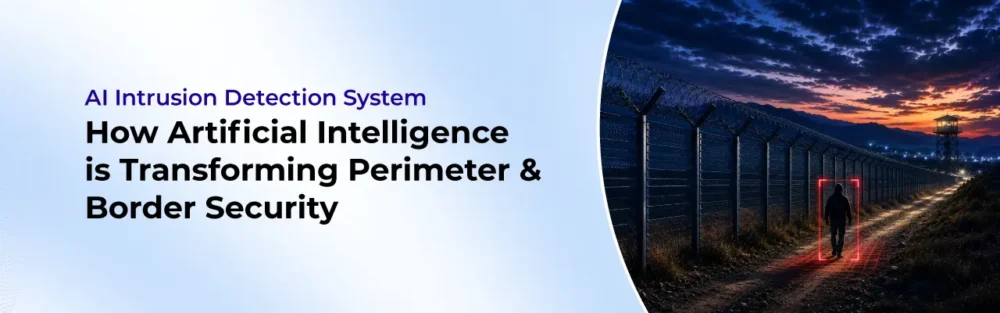
An AI intrusion detection system combines thermal imaging with machine learning to detect threats in any light condition.
Table of Contents
▾
- Introduction
- What Is an AI Intrusion Detection System?
- How an Artificial Intelligence Intrusion Detection System Works
- AI Intrusion Detection vs. Traditional Security Systems
- Thermal Imaging: Detecting Intrusions in Any Light Condition
- Human, Vehicle, and Animal Classification with AI
- Real-Time Tracking and Alerting
- Applications of AI Intrusion Detection Systems
- Why Choose an AI-Based Intrusion Detection System
- The Future of AI Intrusion Detection
- Conclusion
- FAQs
- Related Blogs
Introduction
Security teams protecting borders, military installations, critical infrastructure, and large commercial sites face a common challenge: human operators cannot watch every camera feed, every hour of every day, without fatigue or error. A single missed frame on a monitor can mean a missed intrusion. This is the gap that an AI Perimeter Security system is designed to close.
By combining artificial intelligence with thermal and visual sensing, an artificial intelligence intrusion detection system can watch a perimeter continuously, tell the difference between a person, a vehicle, and a stray animal, and alert security personnel in real time, without waiting for a human to notice movement on a screen. HC Robotics’ AI-based Intrusion Detection System applies this approach using advanced infrared (IR) technology to deliver reliable, always-on perimeter awareness.
What Is an AI Intrusion Detection System?
AnArtificial Intelligence Intrusion Detection System is a security solution that uses machine learning and computer vision to automatically identify unauthorized entry into a monitored area. Rather than simply flagging motion, the system understands what is moving and decides whether it represents a genuine security event.
| Detection Method | AI-powered thermal (infrared) imaging analysis |
|---|---|
| Object Classification | Distinguishes humans, vehicles, and animals |
| Operating Conditions | Day, night, fog, smoke, and low-visibility environments |
| Response | Real-time tracking with instant alerts on potential threats |
| Primary Use Cases | Border security, perimeter defense, critical infrastructure, industrial sites |
See the full capability breakdown on the AI-Based Intrusion Detection System product page.
How an Artificial Intelligence Intrusion Detection System Works
At its core, an artificial intelligence intrusion detection system follows a continuous detect-classify-track-alert cycle:
Continuous Sensing
Thermal or visual cameras capture a live feed of the monitored perimeter, whether that’s a border corridor, a facility fence line, or a restricted zone.
AI-Based Detection
Machine learning models trained on large volumes of thermal and visual data scan each frame to detect potential objects of interest, filtering out background noise like wind-blown vegetation or lighting changes.
Object Classification
Once something is detected, the AI classifies it, typically as human, vehicle, or animal, so security teams immediately understand the nature of the potential threat rather than reacting to an ambiguous alert.
Real-Time Tracking and Alerting
The system tracks the object’s movement across the monitored area and instantly notifies security personnel, enabling a faster, more informed response.
AI Intrusion Detection vs. Traditional Security Systems
Traditional perimeter security relies on passive motion sensors, basic CCTV, or human monitoring, all of which struggle with the same problem: too many false alarms and too little context.
| Capability | Traditional Motion/CCTV | AI Intrusion Detection System |
|---|---|---|
| Distinguishes people, vehicles, animals | No | Yes |
| Works in total darkness | Limited | Yes, with thermal (IR) imaging |
| False alarm rate | High | Significantly reduced |
| Requires constant human monitoring | Yes | Reduced, AI pre-filters events |
| Real-time automated alerts | Basic/none | Yes |
Thermal Imaging: Detecting Intrusions in Any Light Condition
A major limitation of conventional cameras is their dependence on visible light. An intruder moving at night, through fog, or under camouflage can easily defeat a standard camera system. Thermal Intrusion Detection solves this by detecting heat signatures rather than reflected light.
HC Robotics’ system pairs AI analysis with high-quality thermal cameras, capturing detailed imagery that supports reliable intrusion monitoring regardless of lighting conditions, day, night, or adverse weather. This is the same underlying EO/IR sensing approach used in HC Robotics’ EO/IR gimbal cameras for airborne ISR, adapted here for fixed perimeter security.
Human, Vehicle, and Animal Classification with AI
One of the most valuable capabilities of an AI intrusion detection system is accurate classification. Wildlife and stray animals are a leading cause of false alarms in rural, border, and industrial environments. By training AI models to recognize the distinct thermal and movement signatures of humans, vehicles, and animals, the system can:
- Prioritize alerts for human or vehicle intrusions over routine animal movement
- Reduce alert fatigue for security operators monitoring multiple zones
- Improve response precision, since teams know what they are responding to before they arrive
Real-Time Tracking and Alerting
Detection alone isn’t enough, security teams need to know where a target is headed and how urgently to respond. Once an object is classified, the system continuously tracks its movement across the monitored zone, providing:
- Continuous surveillance of identified objects as they move
- Immediate alerts the moment a potential threat is confirmed
- A live operational picture that supports faster, better-informed security decisions
Applications of AI Intrusion Detection Systems
Border and Military Perimeter Security
Persistent, all-weather monitoring of Border Security System corridors and installation perimeters, where manual observation over long distances and long hours is impractical.
Critical Infrastructure Protection
Power plants, airports, data centers, and telecom facilities require continuous perimeter awareness to prevent unauthorized access to sensitive assets.
Industrial and Construction Sites
Large sites with valuable equipment and materials benefit from automated, round-the-clock intrusion monitoring that doesn’t depend on on-site guards alone, complementing broader AI Surveillance System for construction environments.
Commercial and Government Campuses
Large, multi-building properties use AI intrusion detection to secure boundary lines and restricted zones without blanketing every corner with human patrols.
Why Choose an AI-Based Intrusion Detection System
Organizations evaluating perimeter security options should weigh a few key factors: detection reliability in darkness and poor weather, the ability to filter false alarms, and how quickly the system gets a threat in front of a human decision-maker. An AI-Based Intrusion Detection System, thermal-driven intrusion detection system addresses all three by combining always-on sensing with intelligent classification, so security teams spend less time chasing false alarms and more time responding to genuine threats.
The Future of AI Intrusion Detection
AI intrusion detection continues to evolve alongside broader advances in computer vision and sensor fusion. Emerging directions include combining thermal and visual AI with radar and acoustic sensing for even greater detection confidence, tighter integration with drones and EO/IR gimbals for mobile perimeter response, and increasingly autonomous alert triage that helps security teams prioritize the highest-risk events first. As these technologies mature, AI intrusion detection systems will play an even larger role in border security, critical infrastructure protection, and large-scale site security.
Conclusion
An Perimeter Intrusion Detection System turns passive video monitoring into an active, intelligent security layer, one that watches continuously, classifies accurately, and alerts instantly. By pairing artificial intelligence with thermal imaging, HC Robotics’ AI-Based Intrusion Detection System delivers reliable, day-and-night perimeter awareness for border security, critical infrastructure, and large-site protection.
As threats grow more sophisticated and sites grow larger and harder to monitor manually, an artificial intelligence intrusion detection system isn’t just a convenience, it’s becoming a operational necessity for organizations serious about perimeter security.
Frequently Asked Questions
What is an AI intrusion detection system?
An AI intrusion detection system uses artificial intelligence, computer vision, and often thermal (infrared) imaging to automatically detect, classify, and track humans, vehicles, or animals entering a monitored area, sending real-time alerts to security teams instead of relying on manual video monitoring.
What is the difference between an artificial intelligence intrusion detection system and a traditional motion sensor?
Traditional motion sensors and basic CCTV trigger alerts on any movement, including wind, animals, or shadows, leading to frequent false alarms. An artificial intelligence intrusion detection system uses machine learning to classify what is actually moving (human, vehicle, or animal), dramatically reducing false positives and enabling smarter, context-aware alerts.
Can an AI intrusion detection system work at night or in poor visibility?
Yes. Systems that combine AI with thermal (IR) imaging detect heat signatures rather than visible light, so they can identify humans, vehicles, and animals in total darkness, fog, smoke, or adverse weather where standard cameras fail.
Where are AI intrusion detection systems used?
Common applications include border security, military perimeter defense, critical infrastructure protection (power plants, airports, data centers), construction sites, industrial facilities, and large commercial or government campuses.
Does an AI intrusion detection system require new cameras?
It depends on the deployment. Some AI intrusion detection platforms integrate with existing CCTV, DVR, or NVR infrastructure, while dedicated thermal-based systems use purpose-built IR cameras for maximum detection range and accuracy in zero-light conditions.
How accurate is AI at distinguishing humans, vehicles, and animals?
Modern AI intrusion detection systems trained on large thermal and visual datasets can classify humans, vehicles, and animals with high accuracy, allowing security teams to filter out harmless wildlife movement while prioritizing genuine human or vehicle threats.
Related Blogs

Chakshu 18 EO/IR Gimbal: Advanced Military ISR Camera for Border Security
The Chakshu 18 EO/IR gimbal combines EO, thermal, and

Chakshu 18 EO/IR Gimbal for ISR, UAV Surveillance & Reconnaissance
Precision Airborne Surveillance Powered by the Chakshu 18 EO/IR

Revolutionizing Wildlife Monitoring with Advanced Technology
In the realm of wildlife conservation, technology plays a