
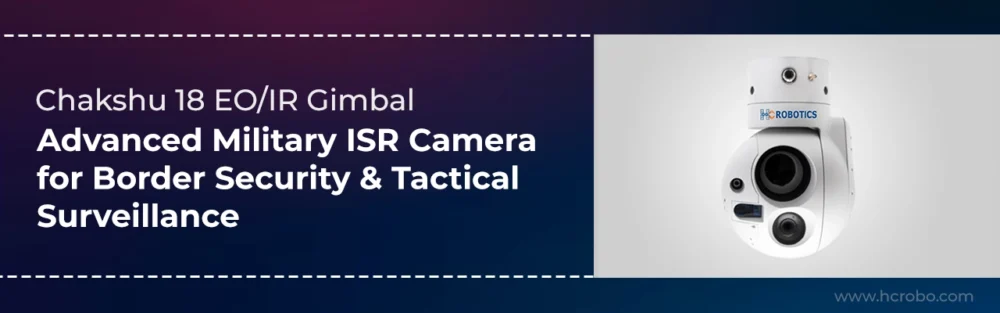
The Chakshu 18 EO/IR Camera combines EO, thermal, and gyro-stabilization in a compact ISR payload.
Table of Contents
▾
- Introduction
- Chakshu 18 Key Specifications
- Why Precision Airborne Surveillance Matters
- Understanding EO and IR Camera Technology
- Why Gyro-Stabilization Is Critical for ISR
- Detection, Recognition, and Identification (DRI)
- How EO/IR Camera Enhance Military ISR Operations
- Military ISR Applications
- The Future of Airborne ISR
- Conclusion
- FAQs
- Related Blogs
Introduction
Whether supporting border dominance operations, conducting tactical reconnaissance, or securing strategic infrastructure, mission success depends on obtaining actionable intelligence at the decisive moment. In today’s operational environment, information superiority often determines battlefield advantage.
The proliferation of Unmanned Aerial Systems (UAS) has fundamentally transformed Intelligence, Surveillance and Reconnaissance (ISR) doctrine, enabling commanders to establish persistent intelligence coverage while reducing risk to personnel. However, the effectiveness of any airborne ISR platform depends on the quality and capability of its onboard sensors. The HC Robotics Chakshu 18 EO/IR Camera is an advanced ISR Camera combines Full HD electro-optical imaging, thermal intelligence collection, precision stabilization, and geo-tracking capabilities in a lightweight payload engineered for mission-critical ISR operations across day and night environments.
Chakshu 18 EO/IR Camera: Key Specifications at a Glance
| Imaging | Full HD electro-optical (EO) camera + 640×480 thermal (IR) detector |
|---|---|
| Zoom | 30× optical zoom for extended tactical stand-off distances |
| Stabilization | Precision gyro-stabilization for stable line-of-sight in flight |
| Tracking | Advanced target tracking with geo-tracking / geo-localization |
| Operating Conditions | Day and night, across haze, smoke, and degraded visual environments |
| Primary Use Cases | Border security, force protection, reconnaissance, critical infrastructure protection |
See full technical datasheet on the EO/IR Gimbal Camera product page.
Why Precision Airborne Surveillance Matters
Airborne ISR provides commanders with persistent battlespace visibility, enabling the detection of hostile activity, monitoring of key terrain, and maintenance of operational awareness across expansive and complex theatres. The ability to rapidly collect, process, and disseminate intelligence directly influences mission effectiveness.
Evolving Threat Landscapes
A border security force monitoring infiltration routes across mountainous terrain faces a different operational challenge than military units conducting force protection around critical assets. Despite differing mission profiles, both require uninterrupted intelligence collection, rapid threat assessment, and real-time battlespace awareness.
The Importance of Real-Time Operational Awareness
Near real-time intelligence enables operators and command elements to assess emerging threats, shorten intelligence-to-action timelines, and maintain decision superiority throughout mission execution. Delays in intelligence can reduce operational flexibility and limit response options.
The Rise of UAV-Based ISR
UAVs have become indispensable ISR assets, providing persistent overhead coverage, expanded reconnaissance reach, and enhanced operational flexibility across contested and denied environments. When equipped with advanced ISR payloads such as the Chakshu 18 EO/IR Camera, they become force multipliers capable of delivering actionable intelligence to commanders at every level. Explore HC Robotics’ full drone and payload product range built for these missions.
Understanding EO and IR Camera Technology
Modern ISR missions require the ability to operate seamlessly across all visibility conditions. The integration of electro-optical and infrared sensors enables military forces to maintain intelligence collection capabilities during both daylight and darkness.
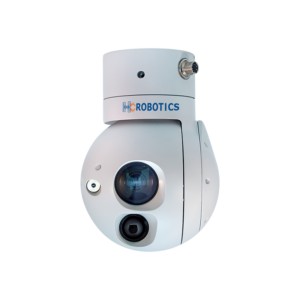
EO sensors deliver visual detail; IR (thermal) sensors detect heat signatures in darkness or haze.
What EO Sensors Deliver
Electro-optical (EO) sensors operate within the visible spectrum and provide high-resolution imagery comparable to human vision. The Full HD EO camera integrated into the Chakshu 18 enables operators to conduct detailed reconnaissance of personnel, vehicles, infrastructure, and terrain features, supporting intelligence preparation of the battlefield and mission planning.
Tactical Advantages of 30× Optical Zoom
ISR platforms operating near hostile positions or contested borders must often maintain tactical stand-off distances to minimize detection and preserve platform survivability. The Chakshu 18’s 30× optical zoom capability allows operators to observe and assess targets at extended ranges while preserving image fidelity, supporting intelligence collection without compromising mission safety.
Thermal Imaging for Target Acquisition
Thermal Imaging Camera significantly enhances target acquisition capabilities by detecting personnel, vehicles, and equipment signatures through darkness, haze, smoke, and degraded visual environments. Equipped with a 640×480 thermal detector, the Chakshu 18 supports sustained intelligence collection even when conventional imaging systems become ineffective.
Multi-Spectral Intelligence Through EO and IR Fusion
EO sensors provide detailed visual identification, while infrared sensors reveal thermal signatures and concealed activity. Together, these systems provide multi-spectral intelligence, improving target detection, classification, and identification while enhancing overall battlespace understanding.
Why Gyro-Stabilization Is Critical for ISR Effectiveness
Image stability directly impacts the quality and reliability of collected intelligence. Unstable imagery reduces DRI effectiveness and limits an operator’s ability to maintain target custody.
Mitigating Airborne Disturbances
Aircraft vibration, wind effects, and maneuver-induced motion can severely degrade image quality. Advanced stabilization systems are essential for preserving ISR effectiveness during dynamic flight profiles.
The Role of Gyro-Stabilization in the Chakshu 18
As a precision Gyro Stabilized Camera, the Chakshu 18 continuously compensates for aircraft movement to maintain a stable line of sight. This enables the collection of intelligence-grade imagery during long-range reconnaissance and precision observation missions.
Enhancing DRI Performance
Stabilization directly enhances Detection, Recognition, and Identification (DRI) performance by maintaining target clarity, extending identification ranges, and supporting accurate intelligence exploitation.
Detection, Recognition, and Identification (DRI): The Core ISR Metric
Detection, Recognition, and Identification (DRI) remains the fundamental benchmark for evaluating EO/IR surveillance performance. Detection determines the existence of a target, recognition classifies its nature, and identification establishes the specific characteristics necessary for operational decision-making and intelligence reporting.
Strong DRI performance enables ISR operators to maintain target custody, support operational planning, and deliver higher-confidence intelligence products to commanders.
How EO/IR Camera Enhance Military ISR Operations
EO/IR Camera represent the primary intelligence collection node within modern UAV ISR architectures. They enable detection, tracking, assessment, and reporting across broad operational areas.
Persistent ISR Coverage
EO/IR Camera enable persistent ISR coverage of areas of interest, supporting long-duration intelligence collection, route surveillance, and pattern-of-life analysis.
Continuous Target Custody
Advanced tracking algorithms allow operators to maintain continuous target custody, reducing the likelihood of losing high-value or time-sensitive targets during dynamic operations.
Day-Night Reconnaissance Capability
Integrated EO and thermal imaging capabilities ensure uninterrupted intelligence collection across all light conditions, maximizing mission effectiveness throughout the operational cycle.
Intelligence-Driven Decision Superiority
Effective command decisions begin with superior intelligence. Real-time EO and thermal feeds provide actionable information for threat assessment, mission planning, and operational coordination.
Military ISR Applications of the Chakshu 18 EO/IR Camera
Border Security and Counter-Infiltration Operations
Modern border security missions require the monitoring of expansive and difficult terrain where adversaries may exploit gaps in coverage. The Chakshu 18 supports detection of unauthorized crossings, monitoring of infiltration routes, and maintenance of persistent ISR coverage across remote sectors.
Military ISR Missions
Modern military operations rely on persistent ISR to support intelligence preparation of the battlefield (IPB), force protection, route reconnaissance, target development, and mission planning. As an advanced ISR payload, the Chakshu 18 combines electro-optical and thermal intelligence collection capabilities to detect, track, classify, and identify threats across diverse operational environments.
Critical Infrastructure Protection
Strategic assets including energy facilities, communications networks, transportation hubs, and defense installations require continuous monitoring. The Chakshu 18 provides persistent overwatch and early warning capabilities to identify security vulnerabilities and potential threats.
The Future of Airborne ISR
The future of airborne ISR will be driven by AI-enabled intelligence exploitation, autonomous sensor tasking, multi-domain operations, and integrated sensor fusion. Next-generation ISR architectures will increasingly combine EO, IR, radar, SIGINT, and geospatial intelligence sources to provide commanders with a comprehensive common operational picture. These advancements will strengthen force protection, border security, strategic surveillance, and mission effectiveness across modern operational environments.
Conclusion
Mission success increasingly depends on the ability to collect, process, and act upon intelligence faster than potential adversaries. The HC Robotics Chakshu 18 EO/IR Camera combines high-resolution electro-optical imaging, thermal intelligence collection, precision stabilization, geo-localization, and advanced target tracking into a compact ISR payload optimized for modern UAV operations.
By delivering mission-critical ISR support across border security, force protection, reconnaissance, target surveillance, and strategic infrastructure security operations, the Chakshu 18 EO/IR Camera enhances operational awareness, accelerates intelligence-driven decision-making, and strengthens mission effectiveness in both permissive and contested environments.
Frequently Asked Questions
An EO/IR Camera is a stabilized camera payload that combines electro-optical (visible-light) and infrared (thermal) sensors on a UAV. It is used for intelligence, surveillance, and reconnaissance (ISR) missions such as border monitoring, force protection, target tracking, and critical infrastructure surveillance, day or night.
What is the difference between EO and IR (thermal) imaging?
EO sensors capture high-resolution visible-light imagery, similar to a standard camera, and work best in daylight. IR (infrared/thermal) sensors detect heat signatures from people, vehicles, and equipment, allowing detection through darkness, smoke, and haze. Combining both gives operators multi-spectral, day-and-night intelligence coverage.
What is DRI (Detection, Recognition, Identification) in ISR?
DRI is the standard benchmark for evaluating EO/IR surveillance performance. Detection confirms a target exists, recognition classifies what type of object it is, and identification determines its specific characteristics, together enabling confident, actionable intelligence reporting.
Why is gyro-stabilization important for an EO/IR Camera?
Gyro-stabilization compensates for aircraft vibration, wind, and maneuver-induced motion to keep the line of sight steady. Without it, imagery becomes blurred or shaky, reducing DRI performance and making it harder to maintain custody of a target during flight.
What is the optical zoom range of the Chakshu 18 EO/IR Camera?
The Chakshu 18 features 30× optical zoom, allowing operators to observe and assess targets at extended stand-off distances while preserving image fidelity, useful for maintaining safety and platform survivability near contested areas.
What applications is the Chakshu 18 EO/IR Camera designed for?
The Chakshu 18 is built for military ISR use cases including border security and counter-infiltration operations, force protection, reconnaissance and target development, and continuous monitoring of critical infrastructure such as energy facilities and transportation hubs.
Related Blogs

Chakshu 18 EO/IR Camera for ISR, UAV Surveillance & Reconnaissance
Precision Airborne Surveillance Powered by the Chakshu 18 EO/IR

Revolutionizing Wildlife Monitoring with Advanced Technology
In the realm of wildlife conservation, technology plays a

Revolutionizing Aerial Surveillance: The EOIR Gimbal Camera
In the rapidly evolving landscape of aerial surveillance, the
For more information on our products and services, Contact Us today. Else, email “info@hcrobo.com and our executives will get in touch with you shortly.