
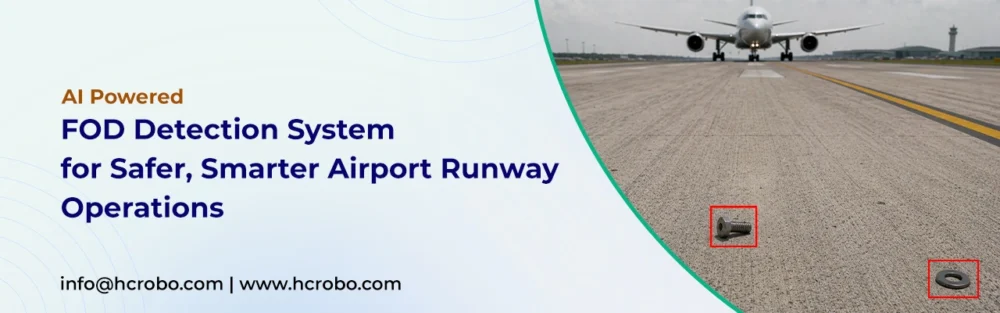
AI Powered FOD Detection System for Safer, Smarter Airport Runway Operations
Table of Contents
▾
- Introduction
- What Is a FOD Detection System?
- Why Runway Hazards Remain a Major Airport Safety Challenge?
- Drawbacks of Manual Runway Inspections
- How AI Powered FOD Detection Systems Work?
- Why Airports Are Moving Toward AI Powered FOD Detection Systems?
- Operational Benefits of an Advanced FOD Detection System
- The Significance of FOD Detection System in the Development of Smart Airports
- How the HC Robotics FOD Detection System Enhances Airport Safety?
- Conclusion
- Key Takeaways
- Frequently Asked Questions
- Related Blogs
Introduction
Runway safety in airports depend on keeping operational surfaces clear of all objects however small, at all times. Even minor debris on runway and operating surfaces can cause significant threat to operating aircraft, especially during take-offs and landings.
With booming air traffic, airports are now increasingly relying on modern technology for enhanced vision, towards effective Aviation Safety risk management. An AI enabled FOD Detection System helps airports maintain safer runways through continuous monitoring, rapid hazard detection and real-time alerts.
What Is a FOD Detection System?
A FOD Detection System is an airport-specific safety system that helps detect existence of debris on runway and promptly alerts operational staff for mitigation measures.
As opposed to conventional approaches of conducting patrols and observations, advanced systems provide continuous monitoring of operational areas and real-time feedback about prevailing runway environment.
In most cases, such FOD detection systems apply analytical capabilities, imaging tools and other object localization features, to assist in runway debris detection.
For airport operators, the ability to identify and respond to runway hazards before they impact flight operations, is a critical safety requirement.
Why Airports Are Adopting Automated Detection Technologies
With increasing complexities at airports, relying on traditional inspection approaches for surveillance purposes is often inadequate. Smart FOD detection solutions gainfully utilize artificial intelligence, assist airports in sustaining situational awareness and detecting potential dangers swiftly.
Why Runway Hazards Remain a Major Airport Safety Challenge?
Nearly 68 % of all aircraft accidents occur during take off and landing phases, which necessitates constant monitoring of runway safety environment. Runways exist in an ever-changing environment and hazards can occur even between scheduled checks. Millimetric sized debris and surface irregularities can pose catastrophic consequences to aircraft during critical phases of take offs and landings.
Aircraft Damage Risks
Debris on runways could cause ingestion induced damage to aeroengines leading to catastrophic failure of engines during take offs, tyre bursts and damage to braking system resulting in brake failures, runway excursions, structural damage to airframe, rupture of fuel tanks etc. (Concorde crash in 2000). In cases of mitigated damages, airlines need to carry out inspection and maintenance work, leading to increased downtime of aircraft.
Operational Implications
Debris/ FOD on runways often result in runway closures, flight delays, higher deployment of resources and resultant inefficiencies. At airports with high traffic density, such problems could lead to flight diversions, chaotic air traffic, increased operating cost and loss of revenue.
Military Aviation Considerations
For military airbases, runway safety directly affects aircraft readiness and mission availability. Efficient and expeditious detection and removal of runway debris, helps maintain operational effectiveness and reduces avoidable downtime.
Drawbacks of Manual Runway Inspections
Manual inspections have been the traditional process used by most airports to ensure debris-free runways for decades now. However, despite their perceived indispensability in airport operations, manual inspections possesses numerous limitations that need immediate redressal.
Inability to Cover the Whole Area
Conventional inspections are carried out periodically. This creates the latent conditions for existence of debris/ FOD during the intervening period of cessation to commencement of runway inspections.
Human Factors
Manual inspections can be affected by weather, lighting, visibility, fatigue, and workload, making it difficult to consistently identify smaller debris across large cross-sections of runway areas.
Increasing Airport Traffic Volumes
With increasing air traffic and airport activity, inspection windows become shorter with increased operational complexities. Maintaining continuous situational awareness using only manual inspection methods becomes increasingly unsustainable in high traffic environment.
Manual Runway Inspections vs AI Powered FOD Detection Systems
| Factor | Manual Inspection | AI Powered FOD Detection System |
|---|---|---|
| Monitoring Frequency | Periodic | Continuous / As per user requirement |
| Coverage Consistency | Variable | Consistent |
| Situational Awareness | Limited | Continuous / As per user requirement |
| Response Support | Manual reporting | Real-time automated alerts |
| Operational Visibility | Inspection based | Real Time / Instantaneous |
AI Powered Automated FOD Detection Systems have enabled a paradigm shift in automated runway monitoring solutions as part of broader airport modernisation initiatives.
How AI Powered FOD Detection Systems Work
Modern FOD Detection Systems combine advanced sensing technologies with intelligent software to create a continuous runway monitoring environment. Rather than waiting for scheduled inspections, the system actively monitors operational surfaces and identifies potential hazards as they appear.
Real Time Data Collection
The system continuously gathers visual and operational data from monitored airfield areas. This creates a constantly updated view of runway conditions and supports immediate hazard detection.
AI Driven Analytics
Artificial intelligence algorithms analyse collected data to identify objects, anomalies, and potential threats. This automated analysis helps reduce detection delays and supports faster decision making by airport operators.
Object Localization
Once a potential hazard is identified, the system determines its precise location on the runway or monitored surface. Accurate localization allows response teams to locate and remove hazards efficiently.
Automated Alerting
When a hazard is detected, the system generates immediate alerts for operational personnel. This enables faster response actions and enhances overall airport safety management.
Why Airports Are Moving Toward AI Powered FOD Detection Systems?
Airports are increasingly adopting AI powered FOD Detection Systems to improve runway visibility, accelerate hazard response and support safer and more efficient operations.
Continuous Runway Monitoring
AI powered systems provide real time visibility of runway conditions, helping operators identify hazards between scheduled inspections.
Support for Smart Airport Operations
Automated detection and intelligent analytics help airports improve operational efficiency, strengthen safety programs, and advance modernisation initiatives.
Operational Benefits of an Advanced FOD Detection System
In addition to improved safety measures, an advanced FOD Detection System provides operational benefits as well.
Lowering the Risk of Aircraft Damage
Timely hazard detection prevents damage to aircraft engines, tyres, landing gears, and other critical components. This reduces maintenance requirements and supports smoother operations.
Faster Hazard Response
Real time alerts enable airside teams to respond quickly when debris is detected. Instead of waiting for scheduled inspections, operators can locate and remove hazards before they impact aircraft operations.
Improved Situational Awareness
Continuous monitoring provides airport personnel with better visibility of runway conditions. This enhanced awareness supports more informed operational decisions and strengthens overall safety management tree.
Greater Operational Efficiency
Automated monitoring reduces dependence on repetitive manual inspection processes and allows personnel to focus on higher value operational activities.
Better Support for Aviation Risk Management
By improving detection speed and response capabilities, airports can strengthen their overall aviation risk management strategy while reducing exposure to avoidable safety events.
The Significance of FOD Detection System in the Development of Smart Airports
Smart airports rely on automation and real time data to improve safety and efficiency. A FOD Detection System supports these goals through continuous runway visibility, faster hazard detection and improved situational awareness. Continuous runway monitoring has become an inalienable part of airport safety and airfield modernization efforts.
How HC Robotics FOD Detection System Enhances Airport Safety
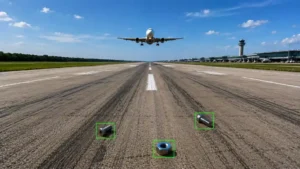
As airports handle increasing traffic and stringent safety requirements, continuous runway awareness becomes essential. HC Robotics FOD Detection System combines AI powered detection, real time monitoring and rapid alerts to help operators identify hazards quickly and improve runway safety.
Hazardous Object Detection as Small as 5 mm
Early detection of objects as small as 5 mm helps airports identify potential hazards before they impact aircraft operations. This supports proactive runway safety management and reduces maintenance related risks.
Real Time Runway Monitoring
Real time monitoring allows airport staff to be aware of any possible dangers on runways in advance, to reduce chances of accidents and incidents.
High Resolution Images
High resolution helps operators verify potential hazards quickly, improving decision making and reducing response time.
Precise Hazard Localization
Precise localization provides information about the exact position of detected objects to enhance efficiency and speed of debris clearance from runways.
Audio Visual Alerting
Immediate alerts enable airside teams to react faster when hazards are detected. Faster response times help reduce runway exposure to potential risks and improve overall safety.
Vehicle Mounted Deployment Architecture
The vehicle mounted design provides operational flexibility across different airfield environment. Airports have access to effective monitoring of own important operational locations without having to install elaborate physical devices. With improved visualization of runway conditions, the system aids efficiency and proactively manages risks.
For airports seeking to strengthen runway safety and operational efficiency, the HC Robotics FOD Detection System provides AI powered monitoring and rapid hazard detection capabilities.
Conclusion
Runway safety requires more than periodic inspections in today’s high traffic aviation environment. Airports need continuous visibility, faster hazard detection, and rapid response capabilities to reduce operational risk.
An AI enabled FOD Detection System allows the fulfilment of aforesaid objectives by providing real-time runway surveillance, intelligent detection, and automatic alerts. With the help of HC Robotics FOD Detection System, operators can quickly detect any potential hazards and increase the security of runways and aircraft manoeuvring areas.
With introduction of smart technologies in airports, AI enabled FOD Detection Systems will become inescapable towards a safer flying environment.
Key Takeaways
- An AI enabled FOD Detection System helps identify runway hazards before they impact aircraft operations.
- Traditional inspection methods provide limited visibility between inspection cycles.
- AI powered monitoring enables continuous runway surveillance.
- Real time alerts support faster debris removal and hazard response.
- Advanced imaging and localization improves detection accuracy.
- Automated runway monitoring strengthens airport safety and operational efficiency.
- HC Robotics provides an intelligent runway monitoring solution designed for modern airport environment.
Frequently Asked Questions
FOD Detection Systems are used to detect foreign objects in aircraft manoeuvring areas and inform airport staff about their presence prior to any safety problems that could arise due to their presence on the runway.
Why is runway debris dangerous?
Debris can cause catastrophic damage to aeroengines, tyres, landing gears, and aircraft airframe structure.
How does AI improve FOD detection?
The AI-powered analytics will constantly monitor the runway condition, provide situational awareness and reduce reaction times.
What are the advantages of implementing real time runway monitoring?
The advantages accrue from detecting hazards more rapidly, improved response times, enhanced safety program and minimized risks.
Can automated FOD detection eliminate human checks?
The technology actually serves the purpose of enhancing FOD detection and mitigation measures. Human checks may be used for validation and site corroboration.
What is the smallest size of foreign objects that can be detected by the HC Robotics FOD Detection System?
HC Robotics FOD Detection System can detect foreign objects of cross-section 5 mm and above.
How can the process of object localization help airport operations?
It helps localize objects on the runway with geo-tagging for subsequent identification of precise site location and directing retrieval team efficiently.
Why do airports embrace AI-driven runway monitoring technology?
AI-driven technology in the form of runway monitoring will enhance safety performance, increase operational efficiency, minimize risks and enable airports’ smartness.
How does the HC Robotics FOD Detection System support airport safety?
HC Robotics FOD Detection System supports airport safety via such measures as: AI driven detection, real time runway monitoring, high-resolution images, precise object localization, automatic alerts and mobility.
Related Blogs

AI Intrusion Detection System: How Artificial Intelligence Is Transforming
An AI intrusion detection system combines thermal imaging with
Chakshu 18 EO/IR Camera: Advanced Military ISR Camera for Border Security
The Chakshu 18 EO/IR Camera combines EO, thermal, and
Chakshu 18 EO/IR Gimbal for ISR, UAV Surveillance & Reconnaissance
Precision Airborne Surveillance Powered by the Chakshu 18 EO/IR
For more information on our products and services, Contact Us today. Else, email “info@hcrobo.com and our executives will get in touch with you shortly.