
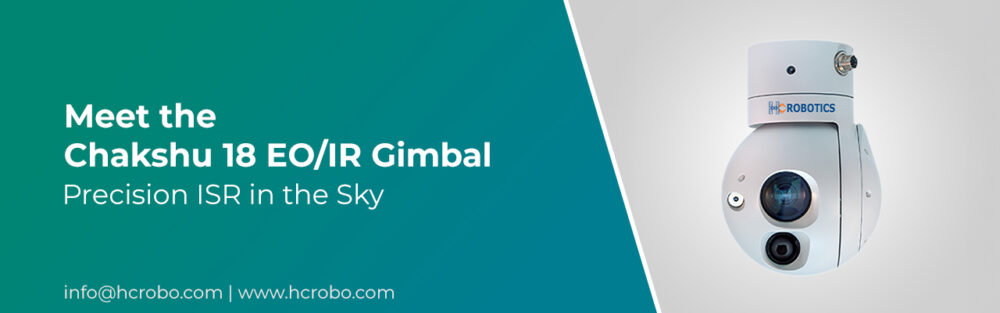
Precision Airborne Surveillance Powered by the Chakshu 18 EO/IR Camera
Table of Contents
▾
- Introduction
- Why Precision Airborne Surveillance Matters
- Understanding EO and IR Technologies
- Why Stabilization Is the Foundation of Effective Surveillance
- Detection, Recognition, and Identification: The Language of ISR
- How EO/IR Camera Improve Airborne Surveillance Operations
- Inside the Chakshu 18 EO/IR Camera
- Real World Applications of the Chakshu 18 EO/IR Camera
- The Future of Airborne Surveillance
- Conclusion
- Frequently Asked Questions
Introduction
Regardless of whether it involves watching over an isolated border area, performing reconnaissance operations, or overseeing essential installations, the common factor remains; getting hold of accurate intelligence at the right time.
The advent of UAVs has revolutionized the manner in which surveillance is carried out, but the usefulness of the data collected hinges on the sensors on board.
The HC Robotics Chakshu 18 EO/IR Camera combines Full HD EO imaging, thermal sensing, precision stabilization, and geo tracking in a lightweight system designed to support reliable airborne surveillance across day and night operations.
Why Precision Airborne Surveillance Matters
Airborne surveillance offers the visibility needed to detect threats, monitor activities, and progress operational awareness across large and complicated environments.
Evolving Security Threats
A border patrol unit monitoring a remote mountainous corridor faces a very different challenge than a police department overseeing a large public gathering. Despite the difference in mission profiles, both depend on the same thing: reliable aerial visibility.
The Importance of Real Time Situational Awareness
In surveillance operations, delays in information can limit response options. Real time situational awareness helps operators assess developing events quickly and respond with greater confidence.
The Emergence of UAV Surveillance
UAVs have become an important surveillance tool because they can cover large areas quickly while operating in locations that may be difficult to access from the ground. When equipped with an advanced ISR payload such as the Chakshu 18, they become highly effective intelligence collection platforms.
An ISR payload is a collection of sensors and technologies mounted on a UAV to support intelligence, surveillance, and reconnaissance operations.
Understanding EO and IR Technologies
Modern ISR missions require visibility in both daylight and darkness. This is why EO and infrared imaging technologies are often integrated into a single ISR payload.
What EO Sensors Capture
Electro optical sensors operate within the visible spectrum and capture detailed imagery similar to human vision. The Full HD EO camera in the Chakshu 18 functions as a capable drone reconnaissance camera, helping operators observe vehicles, infrastructure, terrain, and personnel with clarity.
The Value of Optical Zoom
In many surveillance operations, getting closer is not always an option. A UAV monitoring activity near an international border or observing a potentially hostile area must often maintain a safe stand off distance. This is where optical zoom becomes valuable.
The Chakshu 18’s 30× optical zoom allows operators to examine distant targets without sacrificing image quality, helping gather detailed intelligence while keeping the aircraft safely positioned.
How Thermal Imaging Works
A person moving through dense vegetation after sunset can be difficult to detect with a conventional daylight camera. Thermal cameras have approached the challenge from a different perspective by focusing on heat rather than light.
With the 640 × 480 thermal detector in the Chakshu 18, the person can detect people, cars, and other objects despite the presence of darkness, smoke, or bad weather conditions.
Why EO and IR Work Better Together
EO sensors offer visual detail, while infrared sensors show thermal activity. Together, they deliver a better overview of operations, leading to better decision making ability.
Why Stabilization Is the Foundation of Effective Surveillance
Image stability directly affects the quality of intelligence collected from an airborne platform.
Imaging Challenges in Flight
Aircraft movement, vibration, and wind can reduce image clarity, making long range target observation more difficult.
The Role of Gyro Stabilization
As a precision gyro stabilized camera, the Chakshu 18 continuously compensates for aircraft motion to maintain a stable line of sight. This helps operators capture clearer imagery and improve surveillance performance.
Why the Inner IMU Matters
The integrated inner IMU measures movement and orientation in real time, supporting stabilization performance and artificial horizon computation for enhanced operational awareness.
Stabilization and DRI Performance
Stabilization enhances the effectiveness of Detection, Recognition, and Identification through better maintenance of image clarity and improved target observation.
Detection, Recognition, and Identification: The Language of ISR
Detection, Recognition, and Identification (DRI) is a key measure of EO/IR surveillance performance. Detection refers to determining whether a target is present. Recognition allows operators to understand the general nature of the target, while identification confirms specific characteristics required for intelligence gathering and operational decision making.
Strong DRI performance enables surveillance teams to collect more reliable intelligence and make better informed decisions at greater distances.
Why DRI Matters
Effective DRI performance improves surveillance accuracy and mission effectiveness. High resolution imaging, thermal sensing, optical zoom, and stabilization all contribute to stronger DRI capabilities during ISR operations.
How EO/IR Camera Improve Airborne Surveillance Operations
EO/IR Camera serve as the intelligence gathering core of a UAV payload, enabling operators to monitor, track, and assess activities across large operational areas.
Persistent Monitoring
EO/IR Camera support continuous observation of areas of interest, helping organizations maintain visibility during long duration surveillance missions.
Accurate Target Tracking
Advanced target tracking technology enables operators to maintain visual contact with moving objects while reducing manual workload and improving intelligence collection.
Day and Night Reconnaissance
EO/IR Camera make use of both visual and thermal imaging in order to conduct continuous observation even at night.
Better Decision Making
For surveillance operators, better decisions begin with better visibility. Access to real time EO and thermal imagery enables faster threat assessment, more accurate target tracking, and improved operational coordination.
Inside the Chakshu 18 EO/IR Camera
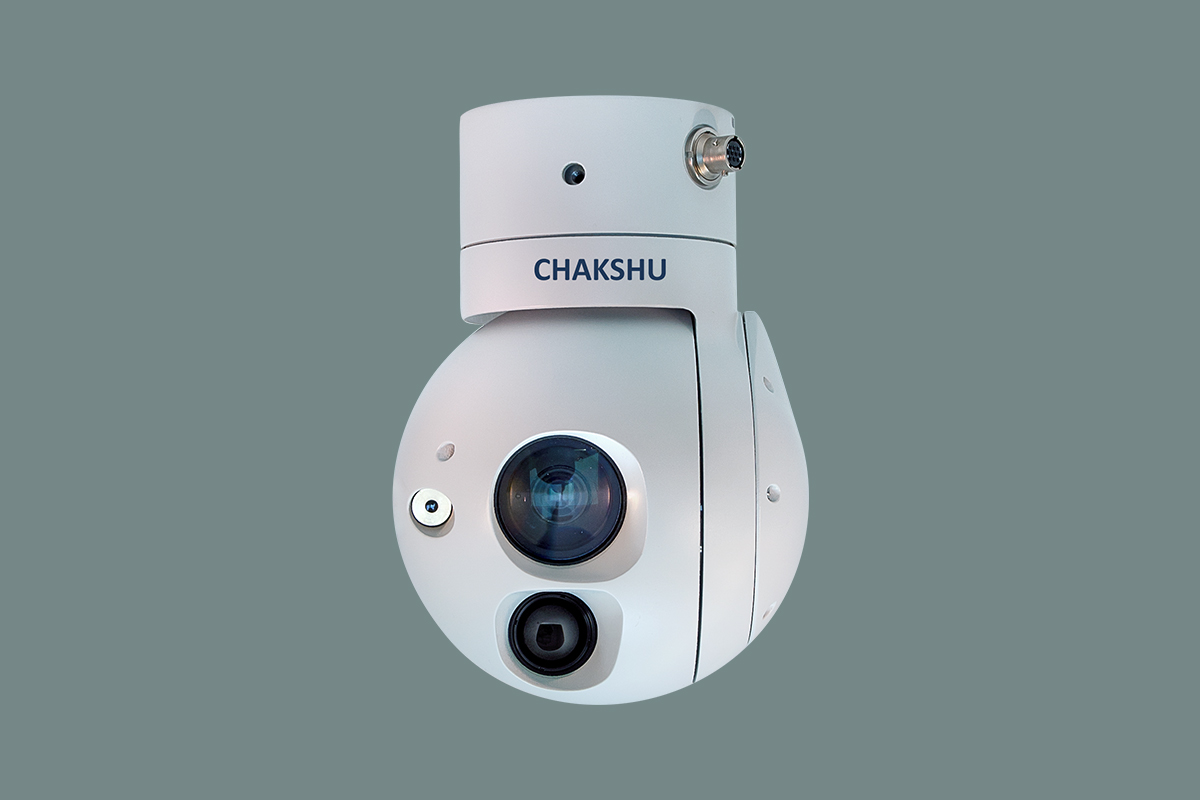
The HC Robotics Chakshu 18 EO/IR Camera combines advanced surveillance capabilities in a compact, lightweight ISR payload optimized for modern UAV operations.
Lightweight Design
Having an extremely lightweight design weighing less than one kilogram, the Chakshu 18 is compatible with many unmanned aerial vehicle platforms without compromising endurance and air performance.
Full HD Electro-Optical Camera
Full HD Electro-Optical (EO) camera provides high-resolution images for surveillance, reconnaissance, and intelligence operations.
30× Optical Zoom
High power 30x optical zoom helps to make distant observation possible while keeping a high-quality image, which allows the operator to obtain intelligence data at a safe distance from a flying object.
640×480 Thermal Detector
The 640×480 thermal detector enables operators to detect and monitor targets in darkness, smoke, haze, and other low-visibility conditions.
Several Infrared Lenses to Choose From
Different surveillance missions require different fields of view and observation ranges. The availability of 13 mm, 19 mm, and 35 mm infrared lenses allows operators to configure the payload according to mission requirements.
Precise Stabilization
The Chakshu 18 functions as a gyro stabilized camera with stabilization performance below 150 μrad, helping deliver clear imagery during UAV missions.
Geo Tracking and Localization
By combining imagery with location data, geo tracking and geo localization help operators determine where a target is located, improving response planning and mission coordination.
Geo localization allows operators to associate observed targets with precise geographic coordinates.
Multi Channel Video Streaming
Simultaneous multi channel streaming allows EO and thermal imagery to be shared across command and control environments in real time.
Direct Drive Architecture
High torque direct drive technology enhances responsiveness, positioning accuracy, and overall stabilization performance.
Optional Laser Pointer
An optional laser pointer supports target designation and mission coordination when required.
Continuous 360° Coverage
Continuous pan and tilt movement enables uninterrupted observation across the operational environment without blind spots.
Real World Applications of the Chakshu 18 EO/IR Camera
Flexibility of Chakshu 18 makes this drone capable of handling many missions in the defence, security, and safety sectors. Chakshu 18’s EO imagery, thermal imaging, stabilization, and geo positioning capabilities help make intelligence collection possible in different types of operations.
Border Security
Modern border surveillance systems must monitor vast and often difficult terrain. The Chakshu 18 helps security agencies detect unauthorized crossings, track suspicious activity, and maintain continuous visibility across remote border regions during both day and night operations.
A UAV surveillance system equipped with the Chakshu 18 can provide persistent visibility across remote border sectors.
Military ISR Missions
Military forces depend on accurate airborne intelligence to support reconnaissance, force protection, and mission planning. As an advanced ISR payload, the Chakshu 18 combines thermal imaging and EO capabilities in a drone reconnaissance camera system that supports tactical surveillance, target observation, and intelligence collection.
Homeland Security
Homeland security organizations employ airborne surveillance systems to help monitor sensitive areas, conduct law enforcement activities, and address potential dangers. The Chakshu 18 assists in improving the situational awareness capability by means of real time intelligence gathering and target acquisition.
Critical Infrastructure Security
Power stations, oil and gas facilities, communication assets, and transportation systems need to be constantly monitored. The Chakshu 18 assists operators in identifying any security vulnerabilities and monitoring restricted areas.
Search and Rescue
In the case of search and rescue operations, time is perhaps the most vital element. With thermal imagery capabilities, rescuers can detect people in hard-to-reach areas.
Disaster Response
Disasters have a tendency to often result in situations wherein the assessment of the situation requires being carried out quickly. The use of UAVs fitted with the Chakshu 18 can help achieve this by providing real time visuals.
The Future of Airborne Surveillance
Airborne surveillance continues to evolve as new technologies improve intelligence collection and operational efficiency. Advanced EO/IR Camera will remain central to this transformation.
Airborne surveillance continues to evolve as AI assisted analytics, autonomous operations, and multi sensor intelligence platforms become more common. Future UAV surveillance systems will increasingly combine EO, thermal, radar, and location data to provide a richer operational picture while reducing operator workload. These developments are expected to strengthen border security, defence surveillance, and critical infrastructure monitoring capabilities.
Conclusion
Successful surveillance requires accurate intelligence and situational awareness through reliable tracking. The HC Robotics Chakshu 18 EO/IR Camera is an ideal ISR sensor that offers full HD EO camera, thermal detection capability, optical zoom up to 30x, stable camera operation, and geo-tracking capabilities as part of its UAV payload system.
In terms of border security and military surveillance through critical infrastructure management and public safety operations, the Chakshu 18 will provide all the insight and information that will make decision making easier.
Frequently Asked Questions
EO/IR Camera are surveillance payloads with an electro optical and infrared sensor assembly used for daytime and night-time imaging purposes in UAVs, drones, and surveillance aircraft.
Why are EO and IR sensors used together?
EO sensors generate high-resolution imagery and allow for identification purposes, whereas the infrared sensors are capable of detecting thermal emissions.
What is the role of stabilization in an EO/IR Camera?
The stabilization of an aircraft offsets any movement, vibration, and turbulence, thus giving clear images and increasing the efficiency of surveillance.
What is DRI performance?
DRI means Detection, Recognition, and Identification. DRI refers to the performance of a surveillance system in detecting, recognizing, and identifying objects at varying distances.
Why is thermal imaging important for ISR missions?
Thermal imaging makes it possible to see targets even in low light conditions because it uses heat signatures rather than the normal optical imaging.
How does 30× optical zoom improve surveillance?
A high optical zoom capability allows operators to observe distant targets while maintaining image quality, supporting long range reconnaissance and intelligence collection.
What applications are EO/IR Camera commonly used for?
EO/IR Camera are widely used in military ISR, border security, homeland security, law enforcement, search and rescue, disaster response, and critical infrastructure protection.
What makes the Chakshu 18 suitable for UAV integration?
Its lightweight sub 1 kg design, advanced stabilization, thermal imaging capabilities, geo tracking features, and compact form factor make it compatible with a wide range of UAV platforms.
Related Blogs

Chakshu 18 EO/IR Camera: Advanced Military ISR Camera for Border Security
The Chakshu 18 EO/IR Camera combines EO, thermal, and

Revolutionizing Wildlife Monitoring with Advanced Technology
In the realm of wildlife conservation, technology plays a

Revolutionizing Aerial Surveillance: The EOIR Gimbal Camera
In the rapidly evolving landscape of aerial surveillance, the
For more information on our products and services, Contact Us today. Else, email “info@hcrobo.com and our executives will get in touch with you shortly.